How Kavach stops trains from passing signals and over-speeding, its versions, components, costs and rollout figures from PIB.
UPSCSSCRRBFacts as of 5 November 20262 min read
In 60 seconds
Kavach is an indigenously developed Automatic Train Protection (ATP) system of Indian Railways.
It keeps trains within speed limits and applies the brakes automatically if the loco pilot does not.
It is certified to Safety Integrity Level 4 (SIL-4), the highest level.
It was adopted as the National ATP system in July 2020; RDSO approved Version 4.0 on 16 July 2024.
Version 4.0 was commissioned on 2,490 route km as on 13 July 2026, mostly on Delhi-Mumbai and Delhi-Howrah.
For your exam
For UPSC Prelims, know that Kavach is an ATP system with SIL-4 certification, developed in India with RDSO. In Mains GS 3, use it under infrastructure and disaster management (rail safety), with the rollout figures and cost per km as evidence.
SSC GK questions are usually one-liners: the name of the system, the ministry, what ATP stands for, or the safety level. Learn the key facts table.
RRB NTPC, Group D and ALP papers ask direct GK on railways: what Kavach is, who developed it, the SIL-4 level and the year it became the National ATP. ALP and JE candidates should also know the five components and how braking is triggered.
What Kavach does
Kavach (Hindi for armour) is an Automatic Train Protection system. It reads the signal and speed limit ahead and shows them to the loco pilot in the cab. If the pilot does not slow down for a speed restriction or a red signal, Kavach applies the brakes on its own. It also helps trains run safely in fog and bad weather, when the pilot cannot see signals clearly.
The five building blocks
Station Kavach at every station and block section.
RFID tags laid along the full length of the track, which tell the train its exact location.
Telecom towers along the section, for radio communication with trains.
Optical fibre cable along the track, linking stations.
Loco Kavach fitted on every locomotive.
Versions
Version 3.2 was the first large deployment, on 1,465 route km of South Central Railway. Version 4.0, approved by RDSO on 16 July 2024, improves location accuracy, gives better signal information in large yards, connects stations to each other over optical fibre and links directly with electronic interlocking.
Timeline
Date
Milestone
February 2016
First field trials on passenger trains
2018-19
Three firms approved to supply Version 3.2
July 2020
Adopted as the National ATP system
16 July 2024
RDSO approves Version 4.0 specification
5 December 2025
Version 4.0 on 738 route km (PIB)
13 February 2026
Version 4.0 on 1,297 route km (PIB)
13 July 2026
Version 4.0 on 2,490 route km (PIB)
Cost and spending
PIB puts the cost at about Rs 50 lakh per km for trackside and station equipment, and about Rs 80 lakh per locomotive. Up to December 2025, Rs 2,573.36 crore had been spent, with Rs 1,673.19 crore allocated for 2025-26. Trackside work had been taken up on 23,360 route km as of February 2026.
Key facts
Type
Automatic Train Protection (ATP) system, developed in India [1]
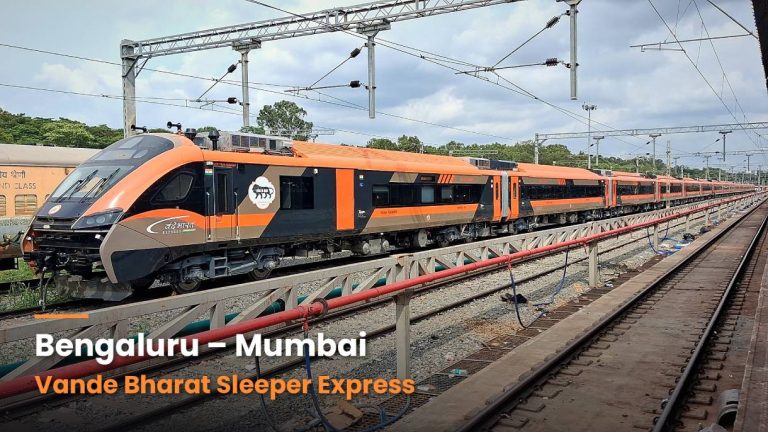
The third Vande Bharat Sleeper route links SMVT Bengaluru with CSMT Mumbai overnight, with stops at Raichur, Yadgir, Wadi and Kalaburagi in North Karnataka.